

You always hear that doing this or that exercise strengthens a certain muscle in your body. But have you ever wondered how many muscles you have or what types? There are about 650 muscles in your body.
Your body muscles perform a variety of vital functions. Some examples are movement, moving food through your digestive system, and letting your heart work and pump blood. In this article, we'll get to know the different types of body muscles and their functions.
-
Types of body muscles :-

The body is made up of three main different types of muscles:-
-
Skeletal muscles Skeletal muscle.
-
Smooth muscles Smooth muscle.
-
Cardiac muscles.
-
First:- Skeletal muscles:-

Skeletal muscles connect to bones through tendons. Each muscle is made of thousands of muscle fibers grouped together. The organized pattern of these fibers forms a striated pattern. That’s why skeletal muscles are also called striated muscles.
Skeletal muscles mainly help in movement. When one muscle contracts, it allows a specific logical body movement. You control the skeletal muscles voluntarily, meaning you decide their movement. They are the only muscles you can control.
-
Locations of skeletal muscles:-
You can find skeletal muscles in almost all parts of the body, like:-
-
Muscles of the head and neck.
-
Muscles of the trunk.
-
Upper limb muscles.
-
Lower limb muscles.
To learn about the anatomical structure of skeletal muscles you can check out the article The structural anatomy of skeletal muscles.
-
The role of skeletal muscles:-
Skeletal muscles have many functions, which include:-
-
Enabling different movements of the body.
-
Maintaining body posture.
-
Generating heat, which helps keep the body temperature stable.
-
They act as a source of nutrients like amino acids.
-
They serve as energy sources during hunger.
-
Secondly :- Smooth muscles :-
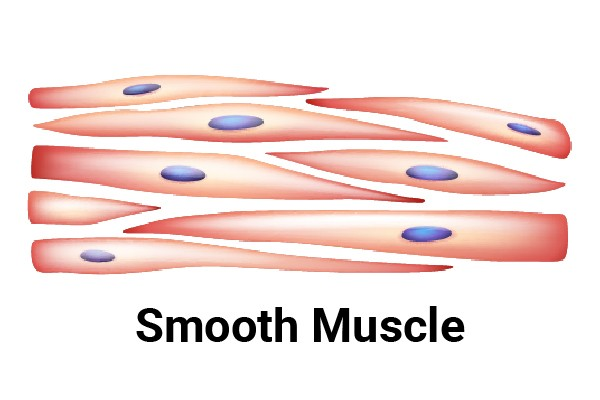
Smooth muscles are involuntary, so you can't control their movement. Each muscle is made of strands of fibers that connect with nearby muscles, forming a network that lets them contract evenly.
Smooth muscle cells are usually rounded near the center and squeezed from the sides. Unlike skeletal muscles, they are not striated. The name smooth muscle refers to how uniform this type looks.
-
Where smooth muscles are found :-
You can find smooth muscles in many body systems, including :-
-
The digestive system.
-
The respiratory system.
-
The circulatory system.
-
The reproductive system.
-
Function of smooth muscles :-
The function of smooth muscles can vary depending on where they are in the body, so here are some functions based on the system they are in:-
-
The digestive system :- Smooth muscles help with contractions that push food through the digestive system.
-
The respiratory system :- Smooth muscles cause the airways to widen or narrow.
-
The circulatory system :- Smooth muscles in the walls of blood vessels help blood flow and also help regulate blood pressure.
-
The urinary system :- Smooth muscles help regulate urine flow from the bladder.
-
The reproductive system :- In the female reproductive system, smooth muscles take part in contractions during pregnancy and childbirth. In the male system, they help push sperm.
-
Smooth muscles are involved Also in some sensory processes, for example, smooth muscles cause the pupil to dilate or contract.
-
Thirdly :- Cardiac muscles :-

As the name suggests, cardiac muscles are in the heart. They are a type of muscle that lets your heart beat. They are involuntary, so you can't control their movement.
The cardiac muscle is one of the three layers of tissue in your heart. It lies between the inner lining of the heart called the endocardium, and the protective sac around the heart called the pericardium.
Like skeletal muscles, cardiac muscles are organized into fibers and look striped. The individual cardiac muscle cells are tightly connected, which helps your heart beat in a coordinated and steady way.
Like smooth muscles, cardiac muscles are involuntary. They contract in response to electrical signals made by a special type of cells in the heart.
-
Locations of cardiac muscles :-
Cardiac muscles are found only in the heart.
-
Function of cardiac muscles:
Cardiac muscles let your heart beat by creating pulses in response to an electrical signal. Heart muscles contract when they receive this signal, which comes from a special type of cell called a pacemaker cell.
-
Some other facts about different body muscles:
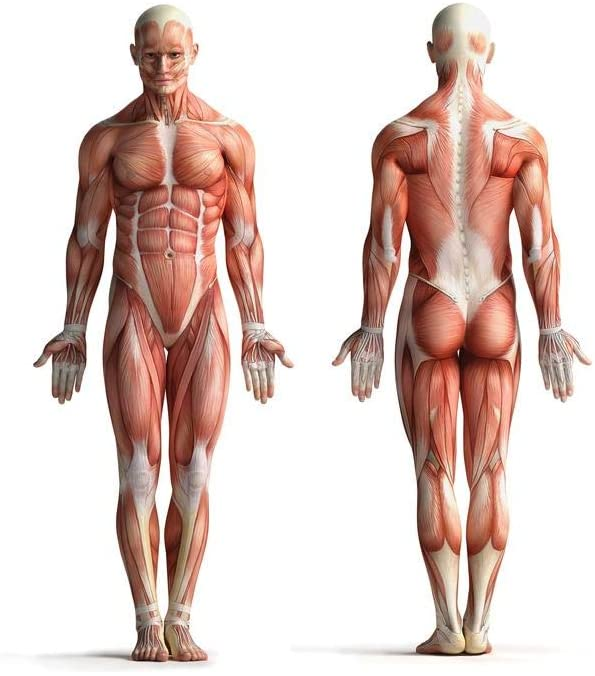
Here are more facts you might still want to know about your different body muscles:
-
Skeletal muscles make up 40-50% of your body's total weight.
-
Skeletal muscle mass starts to decline as you get older, often happening after 40 years old.
-
Your body muscles are made up of 79% water, which shows how important water is for us.
-
The biggest muscles in your body are the gluteus maximus muscles.
-
Heart muscles have limited regeneration, which is why damage from heart diseases causes major health issues.
-
Smooth muscles are very vital, and medicines target these muscles to improve health.


